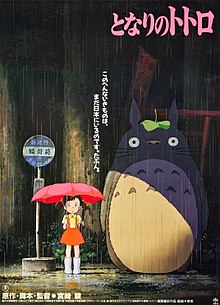
My Neighbor Totoro (Japanese: となりのトトロ Hepburn: Tonari no Totoro?) is a 1988 Japanese animated fantasy film written and directed by Hayao Miyazaki and produced by Studio Ghibli. The film – which stars the voice actors Noriko Hidaka, Chika Sakamoto, and Hitoshi Takagi – tells the story of the two young daughters (Satsuki and Mei) of a professor and their interactions with friendly wood spirits in postwar rural Japan. The film won the Animage Anime Grand Prix prize and the Mainichi Film Award andKinema Junpo Award for Best Film in 1988. It also received the Special Award at the Blue Ribbon Awards in the same year.
The film was released on VHS and laserdisc in the United States by Tokuma Japan Communications' US subsidiary in 1993 under the title My Friend Totoro. In 1988, Streamline Pictures produced an exclusive dub for use on transpacific flights by Japan Airlines.Troma Films, under their 50th St. Films banner, distributed the dub of the film co-produced by Jerry Beck. It was released on VHSand DVD by Fox Video. Troma's and Fox's rights to this version expired in 2004. The film was re-released by Walt Disney Pictureson March 7, 2006[1] and by Madman on March 15, 2006.[2] It features a new dub cast. This DVD release is the first version of the film in the United States to include both Japanese and English language tracks, as Fox did not have the rights to the Japanese audio track for their version.
The movie and its titular character, Totoro, have become cultural icons. My Neighbor Totoro ranked #41 in Empire magazine's "The 100 Best Films Of World Cinema" in 2010.[3] A list of the greatest animated films compiled by Terry Gilliam in Time Out ranked the film number 1.[4] A similar list compiled by the editors of Time Out ranked the film number 3.[5]The character made multiple cameo appearances in a number of Studio Ghibli films and video games and is recognized as one of the most popular characters in Japanese animation. Totoro was ranked 24th on IGN's top 25 anime characters.
Art director Kazuo Oga was drawn to the film when Hayao Miyazaki showed him an original image of Totoro standing in a satoyama. The director challenged Oga to raise his standards, and Oga's experience with My Neighbor Totoro jump-started the artist's career. Oga and Miyazaki debated the palette of the film, Oga seeking to paint black soil fromAkita Prefecture and Miyazaki preferring the color of red soil from the Kantō region.[7]:82 The ultimate product was described by Studio Ghibli producer Toshio Suzuki: "It was nature painted with translucent colors."[8]
Oga's conscientious approach to My Neighbor Totoro was a style that the International Herald Tribune recognized as "[updating] the traditional Japanese animist sense of a natural world that is fully, spiritually alive". The newspaper described the final product:
Oga's work on My Neighbor Totoro led to his continued involvement with Studio Ghibli. The studio assigned jobs to Oga that would play to his strengths, and Oga's style became a trademark style of Studio Ghibli.[9]
The opening sequence of the film was not storyboarded, Miyazaki said, "The sequence was determined through permutations and combinations determined by the time sheets. Each element was made individually and combined in the time sheets..."[7]:27 The ending sequence depicts the mother's return home and the signs of her return to good health by playing with Satsuki and Mei outside.[7]:149
The storyboard depicts the town of Matsuko as the setting, with the year being 1955; Miyazaki stated that it was not exact and the team worked on a setting "in the recent past".[7]:33 The film was originally set to be an hour long, but throughout the process it grew to respond to the social context including the reason for the move and the father's occupation.[7]:54
Miyazaki has said that Totoro is "not a spirit: he's only an animal. I believe he lives on acorns. He's supposedly the forest keeper, but that's only a half-baked idea, a rough approximation."[7]:103 The character of Mei was modeled on Miyazaki's niece.
After writing and filming Nausicaä of the Valley of the Wind (1984) and Castle in the Sky (1986), Hayao Miyazaki began directing My Neighbor Totoro for Studio Ghibli. Miyazaki's production paralleled his colleague Isao Takahata's production of Grave of the Fireflies. Miyazaki's film was financed by executive producer Yasuyoshi Tokuma, and both My Neighbor Totoro and Grave of the Fireflies were released on the same bill in 1988. The dual billing was considered "one of the most moving and remarkable double bills ever offered to a cinema audience".[11]
In 1993, Tokuma Japan Communications' US subsidiary released the first English-language version of My Neighbor Totoro, with the title My Friend Totoro. However, because of his disappointment with the result of the heavily edited English version of Nausicaä of the Valley of the Wind, Miyazaki would not permit any part of the movie to be edited out, all the names had to remain the same (with the exception being Catbus), the translation had to be as close to the original Japanese as possible, and no part of the movie could be changed for any reason, cultural or linguistic (which was very common back then) despite creating problems with some English viewers, particularly in explaining the origin of the name "Totoro". It was produced by John Daly and Derek Gibson, with co-producer Jerry Beck, and was available on VHS and laserdisc. This was the only United States home video release of the film from Tokuma (20th Century Fox would release all upcoming English-language releases of the film until Fox and Troma's rights to the film expired in 2004). Disney's English-language version premiered on October 23, 2005; it then appeared at the 2005 Hollywood Film Festival. The Turner Classic Movies cable television network held the television premiere of Disney's new English dub on January 19, 2006, as part of the network's salute to Hayao Miyazaki. (TCM aired the dub as well as the original Japanese with English subtitles.) The Disney version was initially released on DVD on March 7, 2006, but is now out of print. A reissue of Totoro, Castle in the Sky, andKiki's Delivery Service featuring updated cover art highlighting its Studio Ghibli origins was released by Walt Disney Studios Home Entertainment on March 2, 2010, coinciding with the US DVD and Blu-ray debut of Ponyo.
As is the case with Disney's other English dubs of Miyazaki films, the Disney version of Totoro features a star-heavy cast, including Dakota and Elle Fanning as Satsuki and Mei,Timothy Daly as Mr. Kusakabe, Pat Carroll as Granny, Lea Salonga as Mrs. Kusakabe, and Frank Welker as Totoro and Catbus. The songs for the new dub retained the same translation as the previous dub, but were sung by Sonya Isaacs.
《龍貓》(日语:となりのトトロ)是吉卜力工作室与德间书店於1988年推出的一部动画电影,由宮崎駿所執導。電影描写的是日本在经济高度发展前存在的美丽自然,那个只有孩子才能看见的不可思议世界和丰富的想像,因为唤起观众的乡愁而广受大众欢迎。《龍貓》在1988年4月16日於日本公映[1],大约有80万人次進入电影院观看,同时上映的还有高畑勳執導的電影《萤火虫之墓》。該作也是宫崎骏电影在中国公映的第二部作品。在作品中出现的「五月和梅的家」,亦在2005年日本國際博覽會的濑户市会场中展出
制作契机[编辑]
在1986年的《天空之城》上映結束後,當時為Animage動畫雜誌的編輯長鈴木敏夫打算將宮崎駿已構思多年的《龍貓》內容製成企劃書,請德間書店的企劃高層同意將此案製成動畫上映,不過當時被高層以「故事裡的背景昭和時代,對於一般日本人來說只是充滿貧乏生活的回憶」的理由回絕。[5]
後續因得知新潮社有意推行動畫,[6]鈴木敏夫便想到可以請高畑勳將野坂昭如的小說《螢火蟲之墓》(火垂るの墓)改編成動畫、並與《龍貓》兩片一同上映的點子,但鈴木敏夫的「兩片一同上映」的提案噱頭;被德間高層專務以「先前提的《龍貓》裡頭已經有妖怪了、現在又來一個裡頭有『墓』的東西」的理由痛斥,[7]隨後鈴木敏夫親見新潮社社長佐籐亮一,讓新潮社正式接手出資將《螢火蟲之墓》改編成動畫、並透過德間書店社長德間康快向佐籐亮一協調後,讓《龍貓》與《螢火蟲之墓》成為由同一家動畫工作室製作但經由兩家不同出版社發行的作品。[8]
場景[编辑]
片中的場景為宮崎駿將小時生活周遭的神田川流域景象模樣、當時日本動畫公司所在點多摩市的聖蹟櫻丘附近的景色、以及所澤市一帶景點所融合出的場景。 [9]劇中關於大自然鄉村草木的描繪;則由當時初到吉卜力工作室就職的男鹿和雄擔任,而男鹿和雄所描繪出的成品事後得到宮崎駿的驚嘆,[10]當時在執導《螢火蟲之墓》的高畑勳在觀賞《龍貓》的試映會後;也對男鹿和雄描繪自然景色的技巧深感認同。[11]
開頭曲[编辑]
片頭開頭曲《散步》(さんぽ)的歌詞內容;為宮崎駿委託以《不不幼稚園》(いやいやえん)一書著名的兒童文學作家中川李枝子所創作,而宮崎駿對此曲的要求為「希望能像童話般令人感到親切,並且可讓小孩們立刻記得住、朗朗上口的歌謠」

No comments:
Post a Comment